




RANAL materials for body repair
The current KDV-COLOR page contains a limited RANAL selection: HS High Build 4+1 acrylic primer and HS Professional clear-coat hardener. These two items perform different functions and must not be treated as a ready-made kit.
For the primer, check substrate, required build, thinner, layer count and drying schedule. The clear-coat hardener must be paired with the exact clear coat approved in its documentation.
Avoiding a compatibility mistake
Select the main product first, then find its specified hardener and mixing ratio in the TDS. A component intended for clear coat should not be used with primer merely because both carry the RANAL name.
Requesting other RANAL products
Send KDV-COLOR the exact product name or article number. We will check supply or propose an alternative with the same intended function.
How to choose RANAL materials for a specific repair
Product selection should start with the condition of the panel and the required finish, not simply with price or pack size. Bare metal, an existing coating, plastic, a small local defect and a complete respray may require different preparation systems. Before ordering, identify the substrate, defect depth, repair area, application method and available drying conditions.
When several RANAL products are used in one job, treat them as consecutive parts of one coating system. Each layer must be suitable for the previous surface and provide the correct base for the next operation. For every two-component product, verify the specified hardener, mixing ratio, induction time where applicable and pot life.
- choose filling material by substrate, defect depth, flexibility and sanding method;
- choose primer by adhesion, corrosion protection, filling ability and subsequent coating;
- check application viscosity, flash-off time, temperature and number of coats;
- select the finishing system by appearance, durability and compatible activators or thinners.
Recommended repair sequence
A typical body-repair process includes cleaning and degreasing, removing corrosion and unstable old paint, restoring the panel profile, sanding, priming, applying the colour coat and protecting it with the final finish. The exact operations depend on the damage and on the technical instructions for the selected RANAL product.
Observe the specified flash-off and drying times before applying the next layer. Prepare the surface with the recommended abrasive grade and remove dust carefully. Premature recoating, insufficient degreasing or excessive film thickness can cause shrinkage, delamination, craters, loss of gloss or a visible repair edge.
Common application mistakes
A professional product cannot compensate for an incorrect process. Do not select a hardener only by speed, add thinner without measuring the ratio, or combine unrelated systems without confirmed compatibility. The temperatures of the material, panel and workshop affect atomisation, flow, curing and the final appearance.
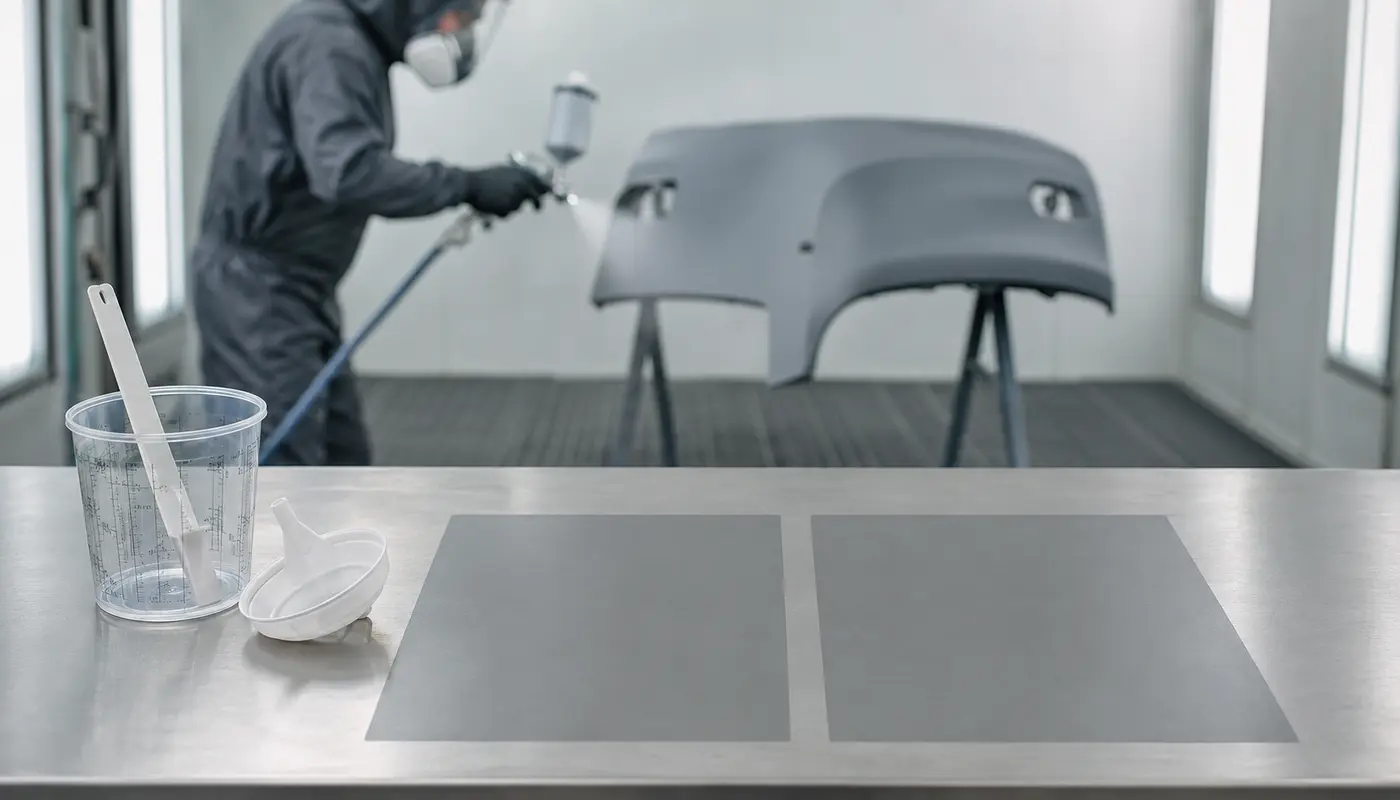
Read the technical data sheet before work, prepare clean graduated mixing cups and verify spray-gun settings. A test application is advisable when matching colour, coating plastic or using a new combination of products. It allows the operator to check coverage, drying and surface appearance before working on the vehicle.
Storage and quantity planning
Keep products in tightly closed original containers away from heat, moisture and direct sunlight. Prevent contamination after opening and observe the stated storage period. Hardeners are particularly sensitive to moisture, so their containers should be closed immediately after dispensing the required amount.
Consumption depends on panel area, number of coats, coverage, transfer efficiency and application technique. Calculate the working quantity with a reasonable allowance, while avoiding excessive purchases of reactive components that may not be used within their recommended period.
Buying RANAL from KDV-COLOR
Use the KDV-COLOR catalogue to compare RANAL products by purpose, pack size, kit contents and current price. Check each product card for technical characteristics and related components. When assembling a complete repair package, verify the whole sequence from substrate preparation to the final protective coat.
For a more accurate recommendation, provide the vehicle or panel type, substrate, nature of the damage, approximate repair area and any products already selected. This information helps identify compatible items and reduces the risk of purchasing components that cannot be used together.
Frequently asked questions
Are the listed primer and hardener compatible with each other?
They should not be assumed to be compatible: the listed hardener is intended for clear coat.
What does 4+1 mean?
It identifies a mixing system, but the exact component and any thinner must be confirmed in the product TDS.